
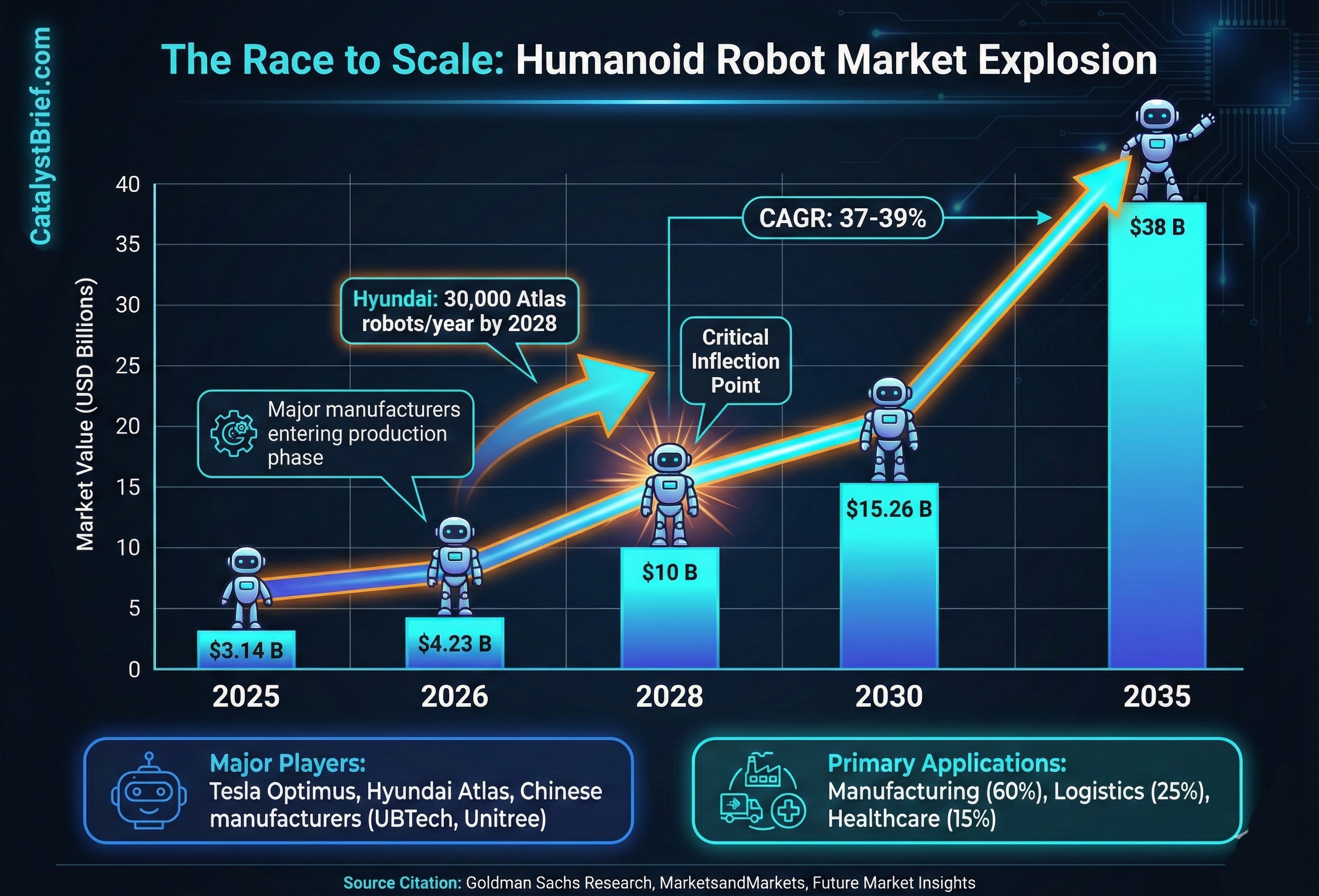
Hyundai Motor Group unveiled a bold plan to manufacture 30,000 Atlas humanoid robots annually by 2028, positioning the South Korean automaker as the first major automotive manufacturer to mass-produce advanced humanoid robots at industrial scale.
The announcement came during Hyundai’s CES 2026 keynote in Las Vegas, where Boston Dynamics, Hyundai’s robotics subsidiary, demonstrated the production-ready version of Atlas in its first-ever public live performance. The all-electric humanoid walked fluidly across the stage, waved to the audience, and rotated its head 360 degrees, showcasing capabilities that extend far beyond traditional industrial robots.
Atlas represents a significant technical leap. The production model features 56 degrees of freedom with fully rotational joints, human-scale hands equipped with tactile sensors, and the ability to lift 110 pounds (50 kg). The robot operates autonomously in temperatures ranging from -4°F to 104°F (-20°C to 40°C), can replace its own batteries for continuous operation, and learns most tasks in under one day.
What sets this deployment apart is the integration of Google DeepMind’s Gemini Robotics AI foundation models. The partnership, announced simultaneously, aims to give Atlas the cognitive capabilities to understand physical environments, reason through problems, and interact naturally with human workers, rather than simply executing pre-programmed routines.
Hyundai’s strategy centers on its Robot Metaplant Application Center (RMAC), opening in 2026, where Atlas robots will undergo training in authentic factory conditions. Data from real-world operations at Hyundai’s Georgia facility will feed back to RMAC, creating a continuous improvement cycle that makes robots faster, smarter, and safer over time.
Atlas robots will begin deployment in 2028 at Hyundai Motor Group Metaplant America near Savannah, Georgia, initially handling parts sequencing tasks. By 2030, the robots will progress to component assembly and eventually take on tasks involving repetitive motions, heavy loads, and complex operations that currently pose safety risks to human workers.
The announcement intensifies competition in the humanoid robotics market, which Morgan Stanley projects could reach $5 trillion USD by 2050. Tesla’s Optimus robot, priced at $20,000 USD to $30,000 USD, targets similar manufacturing applications but has yet to enter production. Chinese firms including UBTech and Unitree are ramping up production with plans for thousands of units in 2026.
Hyundai, which acquired Boston Dynamics from SoftBank in 2021 for $880 million USD, is leveraging its automotive supply chain expertise to drive down production costs while scaling manufacturing capacity. The company has committed $26 billion USD to U.S. operations through 2029, with significant investment directed toward AI-powered robotics manufacturing.
For manufacturing industries globally, Atlas represents a practical solution to labor shortages and workplace safety challenges. The robots handle dangerous, physically demanding tasks while humans focus on oversight, training, and higher-value work. This human-robot collaboration model, what Hyundai calls “human-centered automation,” aims to create safer work environments rather than simply replacing human workers.
The race to deploy capable humanoid robots at scale is accelerating, and Hyundai’s commitment to 30,000 units annually by 2028 marks a pivotal moment in bringing AI-powered physical automation from research labs to factory floors worldwide.