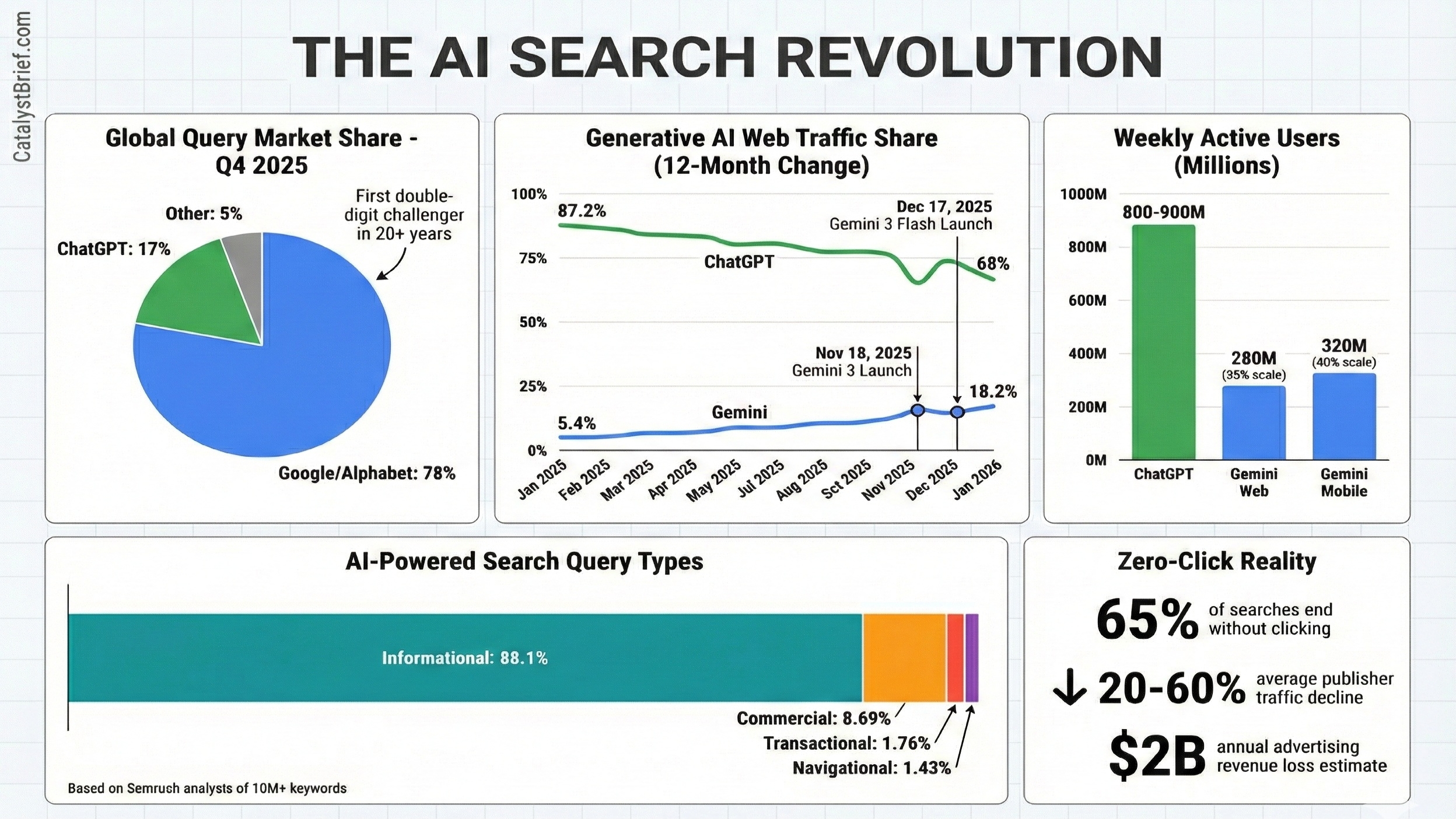
For the first time in over 20 years, a competitor has seized double-digit market share from Google’s search monopoly while Alphabet maintains 78-80% of searches.
The competition intensified dramatically when Alphabet deployed Gemini 3 on November 18, 2025, followed by Gemini 3 Flash on December 17. According to data published January 1, Gemini’s generative AI web traffic share surged from 5.4% to 18.2% over the past year, while ChatGPT’s share in that category dropped from 87.2% to 68%. However, ChatGPT users demonstrate deeper engagement, with sessions averaging significantly longer than traditional search platforms.
The Winner-Take-Most Dynamic
Industry analysts from Andreessen Horowitz described the market as trending toward “winner take all, or at least winner take most.” Partner Olivia Moore noted ChatGPT’s 800-900 million weekly active users vastly outpace Gemini, which reaches around 35% of that scale on web and 40% on mobile. “Things are changing very quickly,” Moore said, noting Gemini is growing desktop users at a faster rate than ChatGPT.

A strategic divide has emerged between the platforms. Google retains dominance in transactional and navigational queries, users seeking local services or specific purchases, while ChatGPT has captured informational and creative searches. According to research firm Semrush, over 88% of queries triggering AI-powered results are informational, compared to just 1.76% for transactional searches.
This division has significant implications for Microsoft, which has invested billions in OpenAI through its partnership. The AI-first approach challenges traditional search economics where advertisers pay for clicks on commercial queries.
The Publisher Crisis
The shift toward AI-synthesized answers has created what industry observers call a “zero-click” reality, with over 65% of searches now resolved directly on results pages. Publishers report traffic declines of 20-60% on average, translating to approximately $2 billion in annual advertising revenue losses across the sector.
The crisis has spawned Generative Engine Optimization (GEO), a new practice where publishers compete to be cited within AI responses rather than ranking in traditional search results. Both OpenAI and Google have struck licensing deals with major media companies, including News Corp and Condé Nast, though smaller independent creators face mounting challenges.
Why This Matters
For quantum computing, biomedical research, and robotics companies relying on search visibility, the implications are profound. AI-powered search excels at synthesizing complex technical information, potentially democratizing access to specialized knowledge while simultaneously disrupting the discovery mechanisms these innovators depend on to reach their audiences.
The shift represents more than a market share battle. It signals a transition from link-based discovery to synthesized knowledge delivery, fundamentally altering the economics of the open web and forcing every organization to reconsider how they connect with users in an AI-first information landscape.