
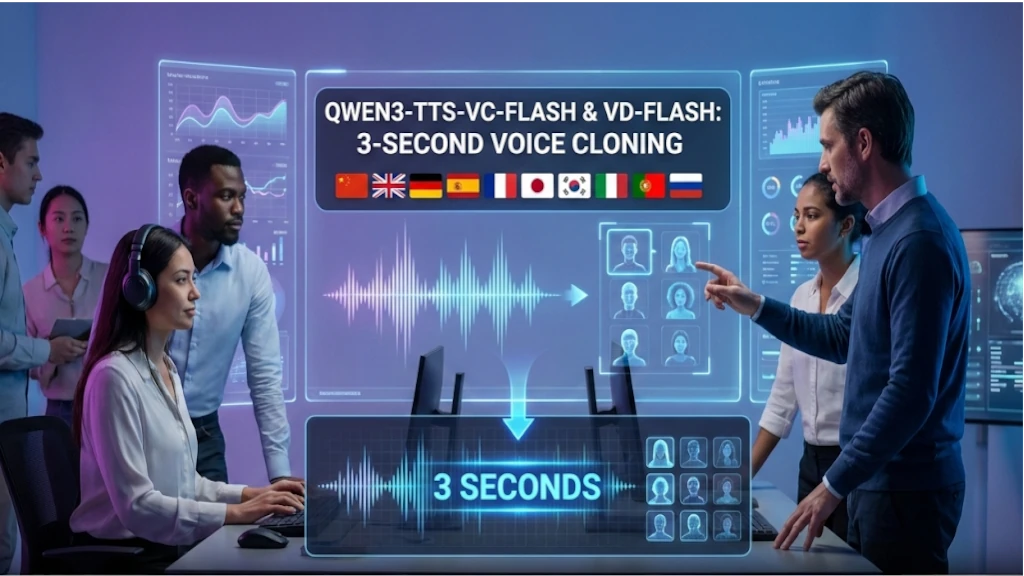
Alibaba’s Qwen team released two breakthrough voice AI models on December 23 that fundamentally change voice cloning economics. Qwen3-TTS-VC-Flash clones voices from just three seconds of audio across 10 languages, while Qwen3-TTS-VD-Flash creates custom voices from text descriptions alone. Both models outperform ElevenLabs in critical benchmarks, positioning Alibaba to compete in the $5 billion USD text-to-speech market projected for 2026.
What Happened
Alibaba Cloud’s Qwen team announced Qwen3-TTS-VC-Flash and Qwen3-TTS-VD-Flash on December 23, 2025. The VC-Flash model achieves voice cloning with only three seconds of source audio, compared to ElevenLabs’ 30-second requirement. This represents a 90% reduction in audio needed for professional-quality voice replication.
The models support 10 languages: Chinese, Russian, English, German, Italian, Portuguese, Spanish, Japanese, Korean, and French. According to Qwen, VC-Flash demonstrates lower word error rates than competing systems from ElevenLabs and MiniMax. The system handles complex text processing, including extracting voices from noisy recordings and imitating animal sounds.
VD-Flash enables voice creation through natural language descriptions. Users can specify characteristics like “Male, middle-aged, booming baritone with hyper-energetic infomercial voice,” and the system generates matching vocal identities without pre-existing audio samples. Both models are accessible through Alibaba Cloud Model Studio API, with demos on Hugging Face.
Why It Matters
The three-second cloning threshold fundamentally changes voice AI deployment economics. Traditional voice cloning required extensive audio collection, creating barriers for small businesses and individual creators. This 90% reduction makes personalized voice experiences accessible to organizations without recording infrastructure.
For multilingual content operations, a single voice clone can now generate content across 10 languages, eliminating multiple voice actors per market. Production companies previously spending $300-500 USD per language on voice talent can clone once and deploy globally at minimal incremental cost.
Technical performance matters because accuracy drives adoption. While ElevenLabs raised $180 million USD at a $3.3 billion USD valuation in January 2025, Alibaba’s superior multilingual performance positions them to capture enterprise customers in non-English markets where Western competitors have struggled. The dual-model approach creates flexibility for different use cases.
Critical considerations around verification and consent remain unresolved. As voice cloning becomes more accessible, organizations deploying these technologies need robust policies around voice data ownership and usage rights. The ability to clone any voice from three seconds raises questions about deepfakes and authentication.
What’s Next
Alibaba’s announcement pressures competitors to match the three-second threshold. Expect ElevenLabs, OpenAI, and Google to respond within months with comparable efficiency or enhanced safety features.
Enterprise adoption will focus on customer service deploying multilingual voice agents, content creators producing audiobooks and podcasts, and gaming studios prototyping character voices.
The voice design model raises intellectual property questions. When voices are generated from text descriptions rather than cloned, who owns them? This ambiguity will likely drive regulatory discussions in 2026.
Watch for integration with Alibaba’s broader AI ecosystem, enabling real-time dubbing and fully voiced AI assistants.
Key Facts
- Qwen3-TTS-VC-Flash clones voices from 3 seconds of audio
- Voice cloning costs $0.01 USD per voice
- Supports 10 languages including Chinese, English, German, Spanish, French, Japanese, Korean, Italian, Portuguese, and Russian
- Text-to-speech market projected to reach $5 billion USD by 2026
- ElevenLabs valued at $3.3 billion USD as of January 2025
- Available via Alibaba Cloud Model Studio API
- Demo versions available on Hugging Face
- New users receive free quota of 1,000 voice creations
- Models outperform ElevenLabs and MiniMax on word error rate benchmarks
- Announced December 23, 2025
Further Reading
Alibaba’s Qwen releases AI model that splits images into editable layers like Photoshop explores Qwen’s latest image editing breakthrough
ElevenLabs raises $180M Series C to be the voice of the digital world details the competitive landscape in voice AI funding
Text-to-Speech Market worth $5.0 billion by 2026 provides comprehensive market analysis and growth projections
Speech synthesis documentation from Alibaba Cloud offers technical implementation details for developers
Qwen3-TTS-Flash Review: The Most Realistic Open TTS Model Yet? examines the broader Qwen TTS family and performance benchmarks