
Google announced plans December 8 to re-enter the smart glasses market with AI-powered eyewear launching in 2026, marking a strategic return a decade after discontinuing Google Glass. The company revealed partnerships with Warby Parker, Samsung, and Gentle Monster to develop glasses built on Android XR, featuring Gemini AI for hands-free assistance. Two versions will launch: audio-only glasses with cameras and speakers, and display glasses with in-lens screens showing navigation and translations.
What Happened
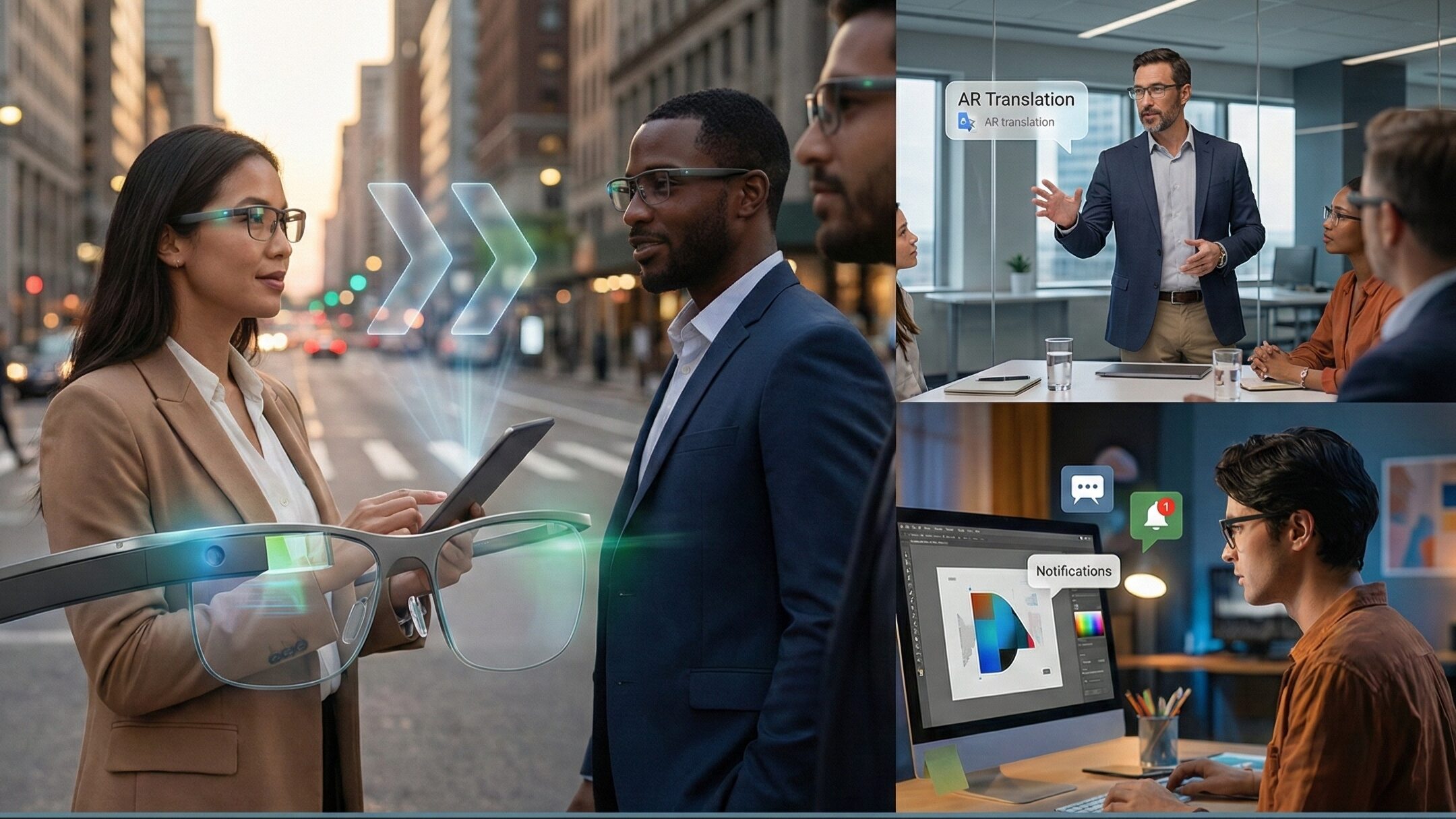
Google’s December 8 livestream unveiled two smart glasses variants launching in 2026, both built on the Android XR operating system. The audio-only version ships first, equipped with cameras, microphones, and speakers enabling Gemini AI interaction without screens. Display glasses follow later, featuring monocular or binocular waveguide displays showing navigation, translations, and notifications in the wearer’s field of vision.
The company committed up to $150 million USD to Warby Parker, with $75 million USD guaranteed for development and $75 million USD milestone-based. Partnerships with Samsung and Gentle Monster will produce multiple designs supporting prescription and non-prescription lenses.
Google released Developer Preview 3 of the Android XR SDK, allowing developers to build optimized apps immediately. The glasses integrate with Android devices and Wear OS, with photo notifications appearing on paired smartwatches. Samsung’s Galaxy XR headset launched at $1,799 USD in October, establishing the platform foundation.
Why It Matters
This marks Google’s attempt to learn from spectacular past failures while capitalizing on explosive growth. The AI smart glasses market surged 210% year-over-year in 2024, with analysts projecting expansion from $1.93 billion USD in 2024 to $8.26 billion USD by 2030.
Google Glass failed in 2013 with a $1,500 USD price, privacy concerns, and clunky design earning users the nickname “glassholes.” Google discontinued sales in 2015 after losing $895 million USD. Co-founder Sergey Brin admitted Glass was “ahead of its time” with inadequate AI and supply chain expertise.
The new approach differs fundamentally. Android XR allows existing Android apps to function immediately without developer modifications, creating ecosystem advantages Meta cannot match. Tech journalists testing prototypes praised augmented reality navigation, with Google Maps projecting directional arrows adjusting to head position. The killer feature is Gemini’s multimodal AI enabling object recognition and persistent visual memory, potentially surpassing Meta’s capabilities.
What mainstream coverage misses is enterprise disruption potential. Boeing and DHL demonstrated 25% efficiency gains using Glass Enterprise Edition in manufacturing.
What’s Next
Expect specific launch dates and pricing announcements in first half 2026, likely at Google I/O in May. Industry observers predict $299-$499 USD for audio-only models, competing with Meta Ray-Ban’s $299 USD entry price. Display versions will likely cost $600-$800 USD.
Watch for Apple’s response. The company holds dozens of smart glasses patents and could accelerate development to prevent Android XR ecosystem dominance. Developer adoption will determine success. If Google attracts robust third-party app development, Android XR glasses could achieve mainstream traction Glass never reached.
Key Facts
- Launch timeline: Screen-free glasses launch 2026; display glasses follow later
- Partnership investment: Up to $150 million USD committed to Warby Parker ($75 million USD guaranteed, $75 million USD milestone-based)
- Market growth: AI smart glasses market grew 210% YoY in 2024, reaching 2 million+ units shipped
- Competitive positioning: Samsung Galaxy XR priced at $1,799 USD vs Apple Vision Pro at $3,499 USD
- Previous failure: Google Glass discontinued January 2015 after $895 million USD loss
- Developer access: Android XR SDK Developer Preview 3 available now with emulator support
- Key features: Gemini AI integration, prescription lens compatibility, Google Maps AR navigation
- Hardware partners: Warby Parker, Samsung, Gentle Monster, XREAL