
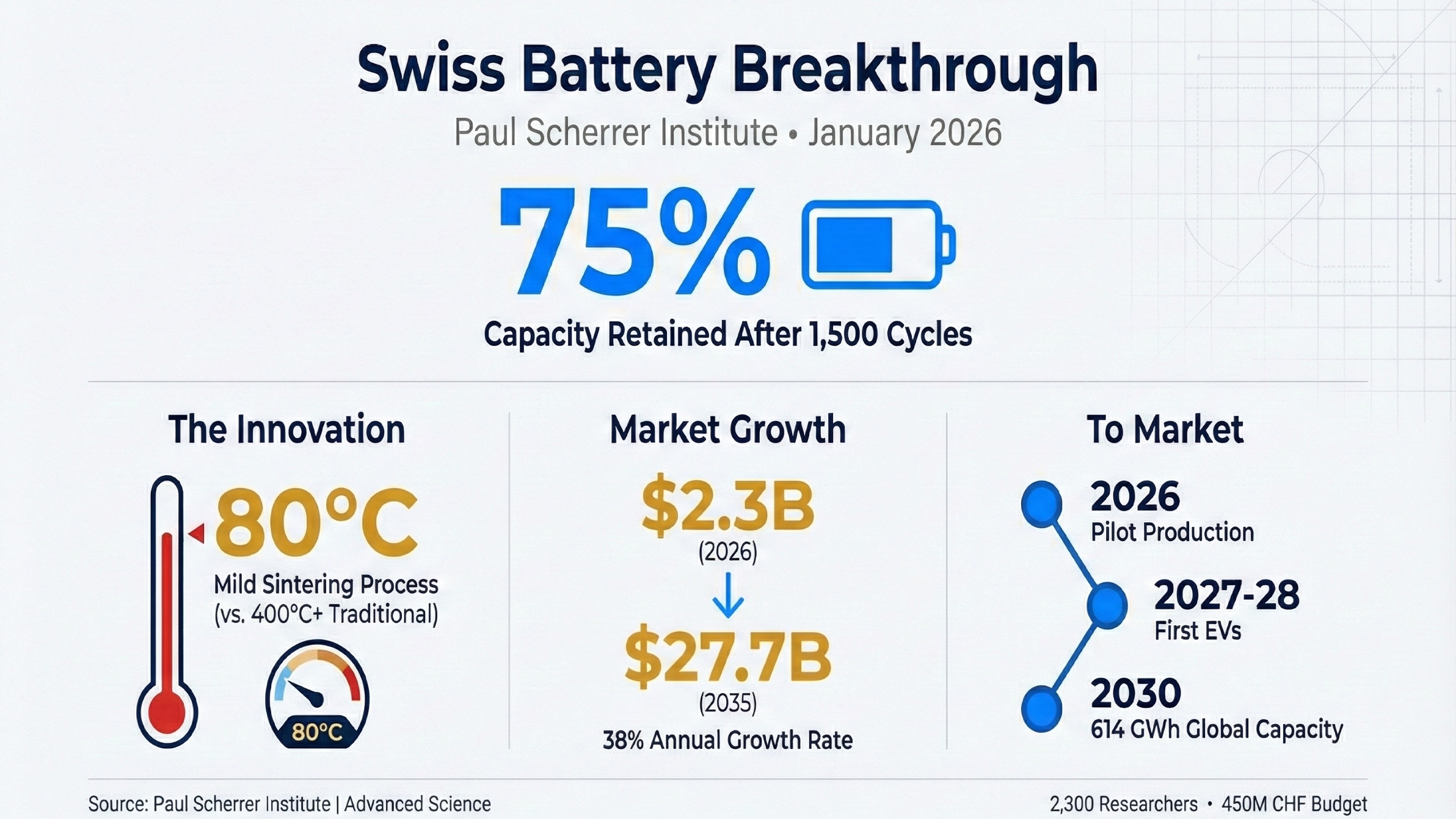
Researchers at Switzerland’s Paul Scherrer Institute achieved a manufacturing breakthrough for lithium-metal solid-state batteries on January 8, 2026, combining low-temperature sintering with ultra-thin coatings to suppress dendrite formation. The process enables batteries retaining 75% capacity after 1,500 cycles, among the best solid-state performance reported. Published in Advanced Science, the work addresses lithium dendrites penetrating electrolytes and unstable anode-electrolyte interfaces.
What Happened
Mario El Kazzi’s Battery Materials and Diagnostics team at PSI developed a manufacturing process that densifies argyrodite solid electrolyte (Li₆PS₅Cl) at 80 degrees Celsius under moderate pressure, far below the 400+ degree temperatures required by traditional sintering. This “mild sintering” creates dense microstructures resistant to dendrite penetration without degrading the sulfide-based electrolyte’s chemical stability. The team then applies a 65-nanometer lithium fluoride coating to the lithium anode surface through vacuum evaporation, preventing electrochemical decomposition at the critical anode-electrolyte interface.
Doctoral candidate Jinsong Zhang led laboratory testing using button cells at high voltage, demonstrating “remarkable” cycle stability. After 1,500 charge-discharge cycles, approximately 75% of lithium ions continued migrating between cathode and anode, maintaining three-quarters of original capacity. El Kazzi emphasized the ecological and economic advantages: “Our approach is a practical solution for the industrial production of argyrodite-based all-solid-state batteries.”
Why It Matters
Solid-state batteries promise higher energy density, faster charging, and safer operation than lithium-ion technology, yet commercialization has been delayed by persistent technical challenges. Major manufacturers including Toyota (targeting 2027-2028) and Samsung SDI (2027 production) have announced timelines, while the global market remains nascent at $2.3 billion USD in 2026.
PSI’s contribution addresses fundamental manufacturing challenges. Previous densification methods created porous microstructures allowing dendrite growth or risked chemical degradation at high temperatures. The mild sintering at 80 degrees Celsius achieves density without thermal damage. Combined with lithium fluoride passivation, this prevents physical dendrite penetration and chemical interface instability.
Industry analysts project 614 GWh global shipments by 2030, with all-solid-state batteries comprising 30% of that total. Current costs remain 5-10 times higher than lithium-ion at $400-800 USD per kilowatt-hour, but low-temperature processing could reduce manufacturing complexity.
What mainstream coverage misses: PSI’s sulfide-based argyrodite validation provides an alternative to oxide-ceramic approaches, potentially integrating with existing roll-to-roll manufacturing equipment.
What’s Next
PSI researchers indicate the technology requires “a few more adjustments” before industrial deployment, suggesting optimization of coating uniformity and scale-up to pouch cell formats. El Kazzi’s statement that “we could get started” implies potential licensing discussions or pilot production partnerships.
The broader timeline shows pilot production lines (0.1-0.5 GWh) targeting first prototypes for automotive qualification in 2026, with commercial vehicles expected 2027-2028. Watch for PSI’s cathode integration publications, industry partnerships through ETH Domain channels, and whether competing institutes validate mild sintering for other sulfide electrolytes.
Key Facts
- Paul Scherrer Institute employs 2,300 researchers across Switzerland’s largest research facility with annual budget of approximately 450 million CHF
- 75% capacity retention after 1,500 cycles represents among best reported performance for solid-state battery systems to date
- Mild sintering at 80 degrees Celsius contrasts with traditional 400+ degree processes that risk electrolyte degradation
- 65-nanometer lithium fluoride coating prevents electrochemical decomposition at anode-electrolyte interface
- Argyrodite Li₆PS₅Cl electrolyte exhibits high lithium-ion conductivity essential for rapid charging
- Global solid-state battery market valued at $1.6 billion USD in 2025, projected to reach $27.7 billion USD by 2035
- Current solid-state production costs estimated $400-800 USD per kWh versus $115 USD per kWh for conventional lithium-ion batteries
- 614 GWh projected global solid-state shipments by 2030, with all-solid-state comprising approximately 30% of total
Further Reading
Paul Scherrer Institute official press release detailing the mild sintering breakthrough and lithium fluoride coating methodology.
Advanced Science research paper by Zhang et al. on synergistic effects of solid electrolyte mild sintering and lithium surface passivation.
Solid-State Battery Market Analysis projecting $27.7 billion USD market by 2035 with 38% compound annual growth rate.
Comprehensive 2026 solid-state battery outlook examining policy drivers, industrialization timelines, and raw material trends.
Toyota’s solid-state battery roadmap targeting 2027-2028 commercialization with nearly triple driving range.