

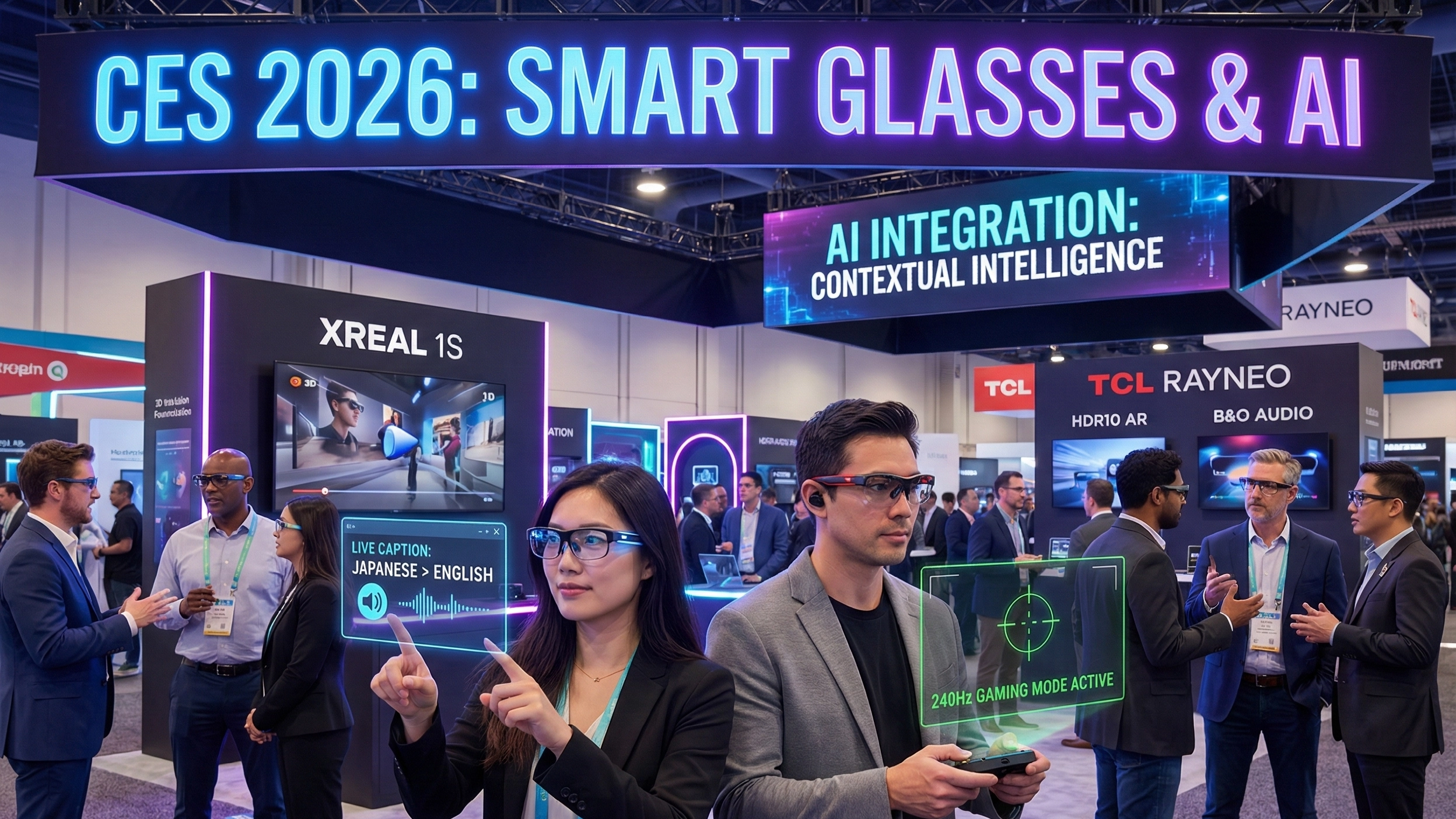
Smart glasses emerged as the defining hardware category at CES 2026, with manufacturers unveiling production-ready augmented reality headsets targeting mainstream consumers rather than developers. The annual technology trade show, held January 6-9 in Las Vegas, drew more than 148,000 attendees and featured over 4,100 exhibitors across 13 venues. The convergence of artificial intelligence with lightweight optical displays defined announcements from established AR manufacturers and gaming brands entering the spatial computing market for the first time.
What Happened
Xreal launched the 1S at $449 USD on January 4, undercutting its predecessor by $50 USD while upgrading display resolution to 1200p and brightness to 700 nits. The glasses feature Real 3D conversion powered by the onboard X1 spatial computing chip, transforming 2D video into stereoscopic 3D without external apps or subscriptions. Asus partnered with Xreal to debut the ROG Xreal R1, positioning 240Hz micro-OLED panels as the first refresh rate-focused gaming glasses. TCL RayNeo announced the Air 4 Pro at $299 USD, claiming the title of first consumer HDR10-enabled AR glasses with Bang & Olufsen audio tuning and January 25 availability. Projector manufacturer Xgimi introduced MemoMind, a sub-brand launching AI glasses at $599 USD with multi-LLM operating systems pulling from OpenAI, Azure, and Qwen. Captify Pro glasses, designed specifically for accessibility, provide live captioning and translation across 40 languages at $899 USD retail pricing.
Why It Matters
Consumer-ready smart glasses with sub-$500 USD price points compress adoption timelines hardware analysts projected for 2027-2028. TCL RayNeo positions HDR10 capability and 1,200 nits brightness at $299 USD, forcing competitors to match specifications or justify premium pricing through software ecosystems. Gaming applications received dedicated hardware through Asus targeting competitive scenarios with 240Hz refresh rates and 3ms latency matching desktop monitors. The ROG Xreal R1 Control Dock transforms handheld devices into virtual 171-inch displays without external monitors.
AI integration moved beyond voice assistants to contextual intelligence on custom processors. Xreal Real 3D operates entirely on X1 chips without cloud dependencies, while MemoMind selects optimal language models per task. Captify Pro addresses 1.5 billion people experiencing hearing loss through beamforming microphones isolating speakers in noisy environments. Industry consolidation through optical manufacturer and gaming brand partnerships suggests AR glasses will follow smartphone development patterns, with hardware commoditization pushing differentiation into software platforms. Google announcing Android XR collaboration with Xreal accelerates this trend, though platform fragmentation risks incompatible user experiences.
What’s Next
TCL RayNeo Air 4 Pro launches January 25, testing whether consumers prioritize HDR capability over brand recognition at aggressive prices. Asus ROG Xreal R1 ships H1 2026 without confirmed pricing, though previous models debuted at $699 USD. MemoMind preorders open after CES 2026, with Memo One availability following. Platform fragmentation remains unresolved as manufacturers pursue proprietary software. Android XR partnerships from Google and Samsung suggest consolidation attempts, but Apple reportedly developing competing glasses maintains ecosystem divisions. Independent auditors publish verified CES 2026 attendance figures in spring.
Key Facts
- CES 2026 drew 148,000 attendees across January 6-9 in Las Vegas
- Xreal 1S launched at $449 USD with 1200p resolution and Real 3D conversion
- TCL RayNeo Air 4 Pro priced at $299 USD, first consumer HDR10 AR glasses
- Asus ROG Xreal R1 features 240Hz micro-OLED, industry-first gaming refresh rate
- MemoMind Memo One starts at $599 USD with hybrid-LLM AI system
- Captify Pro provides live captioning in 40 languages at $899 USD retail
- Google announced Android XR partnership with Xreal for platform development
- Over 4,100 exhibitors participated across 13 Las Vegas venues
Further Reading
Xreal 1S AR Glasses Debut at CES 2026 With Built-In 3D Video and Lower Price – Cybernews analysis of Xreal pricing strategy and Real 3D technical implementation
Asus ROG and Xreal partner to deliver gaming-optimized AR glasses – Tom’s Hardware hands-on review of 240Hz performance and Control Dock functionality
TCL Unveils World’s First HDR10 AR Glasses: RayNeo Air 4 Pro at CES 2026 – TCL Central breakdown of display specifications and Bang & Olufsen audio tuning
XGIMI Goes Beyond the Screen at CES 2026 with MEMOMIND – Official announcement detailing hybrid-LLM architecture and modular design options
Smart glasses steal the show on the CES show floor – Industry analysis covering Captify Pro accessibility features and platform fragmentation challenges