
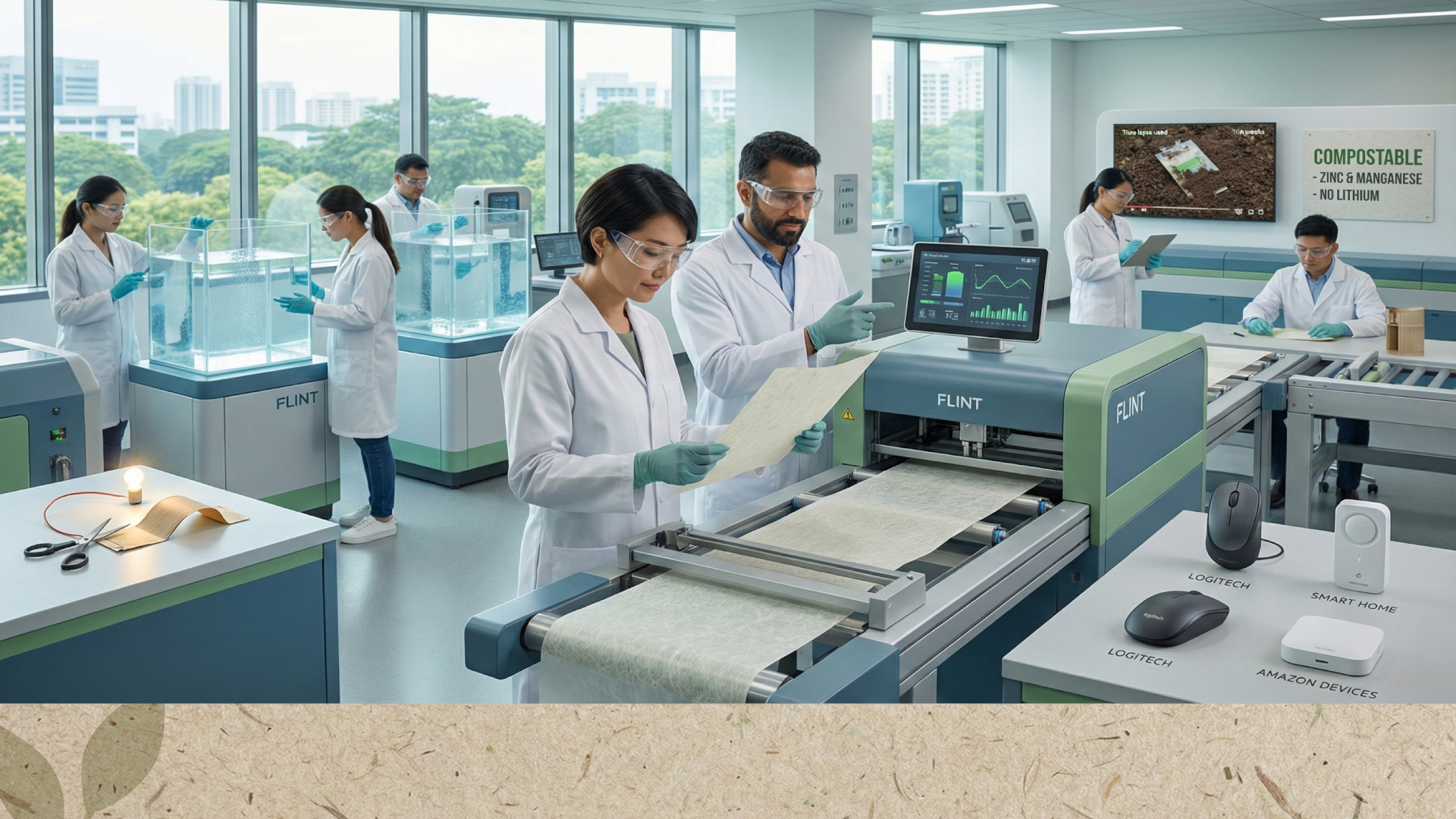
Flint’s cellulose-based batteries have entered volume production in Singapore, transitioning from laboratory development to manufactured cells now supplying pilot programs with major technology companies. The 8,000-square-foot facility uses water-based manufacturing methods designed to eliminate lithium, nickel, cobalt, and lead from the battery supply chain. The rechargeable cells are engineered to be non-flammable and non-explosive, with components that biodegrade after extraction of non-compostable materials.
What Happened
Flint announced production began on January 2, 2026, marking the company’s shift from prototype demonstration to scaled manufacturing. The Singapore-based startup revealed it is now supplying manufactured battery cells to pilot programs with Logitech and Amazon Devices, following recognition at CES 2025 where Flint received the Best of CES Sustainability Award. Carlo Charles, founder and CEO who was named to Forbes’ 30 under 30 Asia 2025 in Industry, Manufacturing & Energy, stated the production milestone enables paper batteries to “move beyond prototypes and into real devices, at real volumes, with quality controls that customers can validate.” The company raised $2 million USD in 2025 through a pre-Series A round involving angel investors and co-founders.
Why It Matters
Battery manufacturing has concentrated around lithium supply chains dominated by Chinese processing facilities, creating geopolitical vulnerabilities and environmental concerns. Flint’s cellulose-based chemistry uses zinc and manganese rather than rare earth minerals, potentially enabling localized production closer to end markets. The technology addresses three persistent battery industry challenges: safety risks from thermal runaway events, disposal problems from toxic materials, and cost barriers limiting adoption in developing markets.
Current lithium-ion batteries cost approximately $115 USD per kilowatt-hour, while Flint’s production costs run at roughly 10% of that figure. The company projects further scaling could reduce costs below $50 USD per kilowatt-hour. Each battery unit delivers 600 milliampere-hours capacity, suitable for consumer electronics, medical devices, and Internet of Things applications where energy density requirements are lower than electric vehicles.
The safety profile differentiates these batteries from lithium-ion technology. Paper batteries continue operating when cut, bent, or punctured without igniting, addressing fire risks that caused 277 incidents and six deaths in New York City during 2024. The cellulose-based components biodegrade in approximately six weeks when composted, contrasting with conventional batteries that persist for decades while leaching heavy metals.
What’s Next
Flint will unveil two commercial paper battery products at CES 2026 in January, demonstrating real-world customer integrations and performance specifications. The company is negotiating with an unnamed contract manufacturer to expand production capacity in Europe, diversifying supply chains beyond Singapore. Parallel research continues on solid-state derivatives of the cellulose chemistry targeting higher energy density applications.
Near-term priorities focus on pilot deployments with technology partners including Logitech’s device applications and Amazon’s Climate Tech Accelerator program supported by MIT. The company must demonstrate lifecycle durability and performance consistency at manufacturing scale to compete with established lithium-ion suppliers who have optimized production over decades.
Key Facts
- Production facility: 8,000+ square feet in Singapore
- Funding raised: $2 million USD (2025 pre-Series A round)
- Battery capacity: 600 milliampere-hours per unit
- Production cost: Approximately 10% of lithium-ion batteries
- Biodegradation time: Six weeks when composted
- Operating temperature range: -15°C to 80°C
- CEO recognition: Forbes 30 under 30 Asia 2025
- Major award: Best of CES Sustainability Award (CES 2025)
Further Reading
CES 2025: Flint Unveils Biodegradable Paper Batteries – Technical overview of the hydrogel-based design enabling biodegradability and safety improvements over lithium-ion technology.
Singapore firm unveils paper batteries that decompose in 6 weeks – Coverage of Flint’s cost advantages and planned manufacturing expansion across multiple continents.
Flint wants to disrupt the battery industry with paper – Deep dive into the chemistry behind cellulose-based batteries and challenges scaling energy density to match lithium-ion performance.
It’s Now Possible to Make Batteries Out of Paper – Analysis of paper battery safety testing, fire risk comparisons, and potential applications across consumer electronics and medical devices.
This “Paper” Battery Could Change How EVs Are Built – Exploration of Flint’s production scaling challenges and discussions with global contract manufacturers for European capacity expansion.