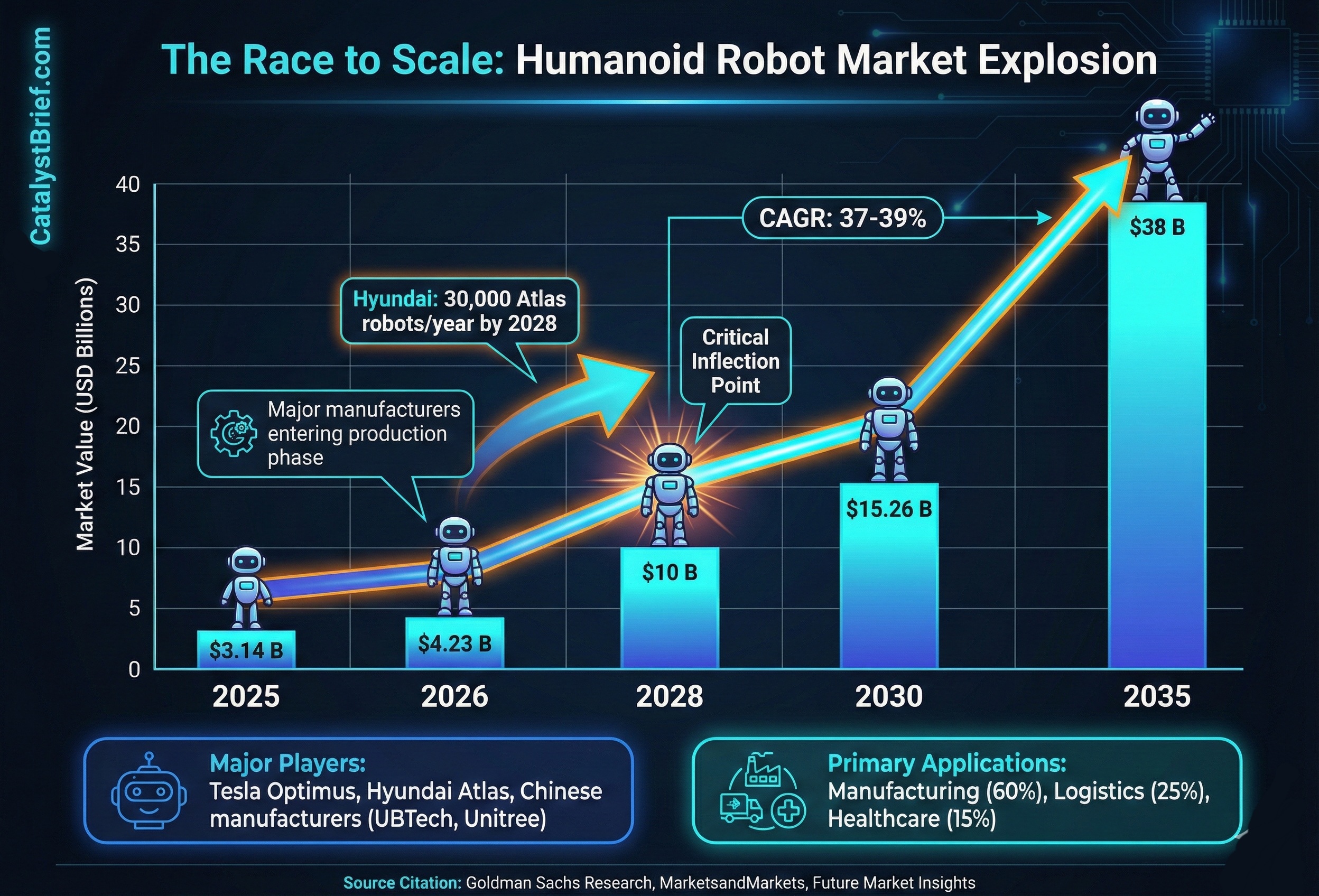

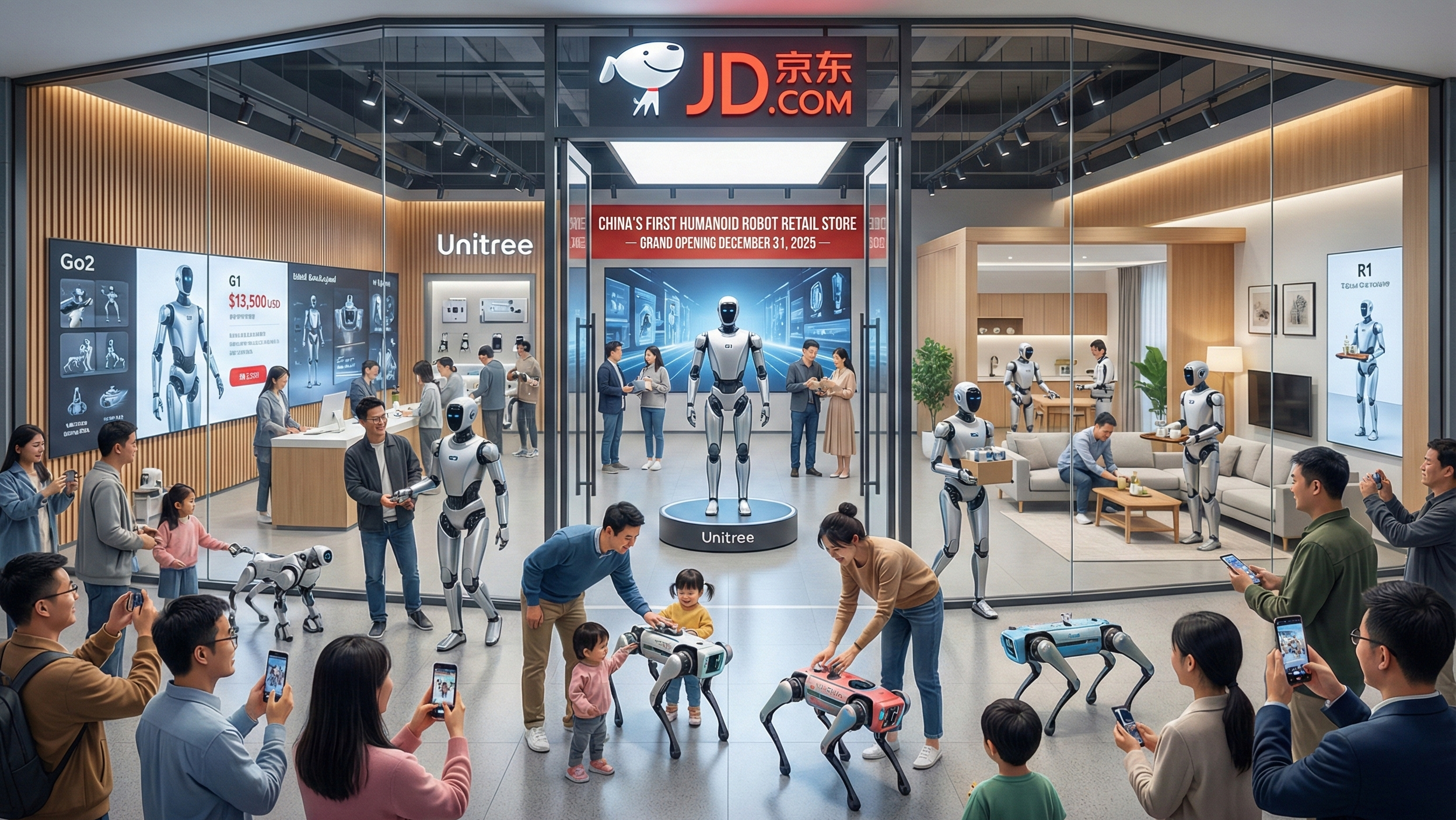
Chinese robotics manufacturer Unitree opened its first physical retail store on December 31 in Beijing, partnering with e-commerce giant JD.com to showcase humanoid robots including the G1 model and Go2 quadruped alongside hands-on demonstrations. The store, located at JD Mall in the Chaoyang district, marks a decisive shift from online-only sales to in-person experiences as Chinese companies race to commercialize AI-powered robots while Tesla struggles to bring its Optimus robot beyond prototypes.
What Happened
Unitree and JD.com officially launched the world’s first offline humanoid robot retail store at 10:58 AM on December 31, 2025, at JD Mall Beijing Shuangjing. The store features Unitree’s G1 humanoid robot priced at $13,500 USD, H1 model at $90,000 USD, and Go2 quadruped robots ranging from $1,400 to $2,800 USD. Customers can interact with robots in simulated home care scenarios, purchase in-store, or order via QD.com’s platform for pickup or delivery.
JD.com announced a robot rental service offering daily or long-term leases to address high upfront costs. The initiative is part of JD.com’s Intelligent Robotics Industry Acceleration Plan, committing $1.4 billion USD over three years to help 100 robotics brands achieve $140 million USD in sales each.
Unitree achieved $129 million USD in revenue in 2024 while maintaining profitability, delivering 1,500 humanoid robots and controlling 69.75% of the global quadruped market with 23,700 units sold.
Why It Matters
The Beijing store opening signals China’s aggressive push to dominate humanoid robotics commercialization while Western competitors remain trapped in prototype phases. Unlike Tesla’s Optimus program, which targets 5,000 units in 2025 but faces production uncertainties, Chinese manufacturers are delivering thousands of units at prices undercutting Western alternatives by 85-95%.
This price advantage stems from supply chain dominance. Morgan Stanley Research found Chinese supply chains enabled costs to drop 40% from 2023 to 2024, versus earlier projections of 15-20% annually. Chinese manufacturers control approximately 70% of critical components including batteries, sensors, and rare earth magnets, allowing Unitree to price the R1 at $4,500 USD compared to competitors charging $150,000-$250,000 USD.
The retail strategy reveals sophisticated go-to-market tactics missing from Western approaches. Unitree focuses on consumer accessibility through affordable pricing, rental options, and experiential retail. JD.com’s 8 million enterprise customers and 600 million consumers provide scale advantages unavailable to venture-backed startups.
China’s government backing accelerates this advantage, triggering 610 investment deals totaling $7 billion USD in the first nine months of 2025, up 250% year-over-year.
What’s Next
Unitree plans to file for IPO by year-end 2025, potentially becoming China’s first publicly traded humanoid robotics company with a valuation approaching $7 billion USD. CEO Wang Xingxing expects humanoid robots to achieve household capabilities including room tidying within 1-2 years.
Tesla plans to unveil Optimus V3 in Q1 2026 targeting a one-million-unit production line by late 2026. However, analysts remain skeptical given timeline delays and June 2025 resignation of program head Milan Kovac.
Watch for additional Chinese manufacturers opening retail locations throughout 2026 as competition intensifies for global humanoid robotics dominance.
Key Facts
- Store Opening: December 31, 2025, at 10:58 AM at JD Mall Beijing Shuangjing, Chaoyang district
- Product Pricing: G1 humanoid $13,500 USD; H1 humanoid $90,000 USD; R1 humanoid starting at $4,500 USD; Go2 quadruped $1,400-$2,800 USD
- Unitree 2024 Performance: $129 million USD revenue, 1,500+ humanoid robots delivered, 23,700 quadruped robots sold (69.75% global market share)
- JD.com Investment: $1.4 billion USD committed over three years to support 100 robotics brands
- China Funding Surge: 610 investment deals totaling $7 billion USD in first nine months of 2025, up 250% year-over-year
- Cost Reduction: Manufacturing costs dropped 40% from 2023 to 2024 due to Chinese supply chain advantages
- Tesla Production Targets: 5,000 Optimus units planned for 2025, scaling to 10,000 units monthly by mid-2025
- Market Projections: Global humanoid robot market could reach $5 trillion USD by 2050, with China’s market reaching $10.3 billion USD by 2029