
Canadian scientists have developed autonomous vessel fleets that use reinforcement learning to maintain ice-free shipping channels in Arctic waters, addressing a critical limitation of traditional icebreakers that lose effectiveness as broken channels refreeze within hours. The National Research Council of Canada and Memorial University collaboration represents a significant step toward year-round navigation in Northern shipping routes, leveraging swarm robotics principles to create persistent ice management without continuous human oversight.
What Happened
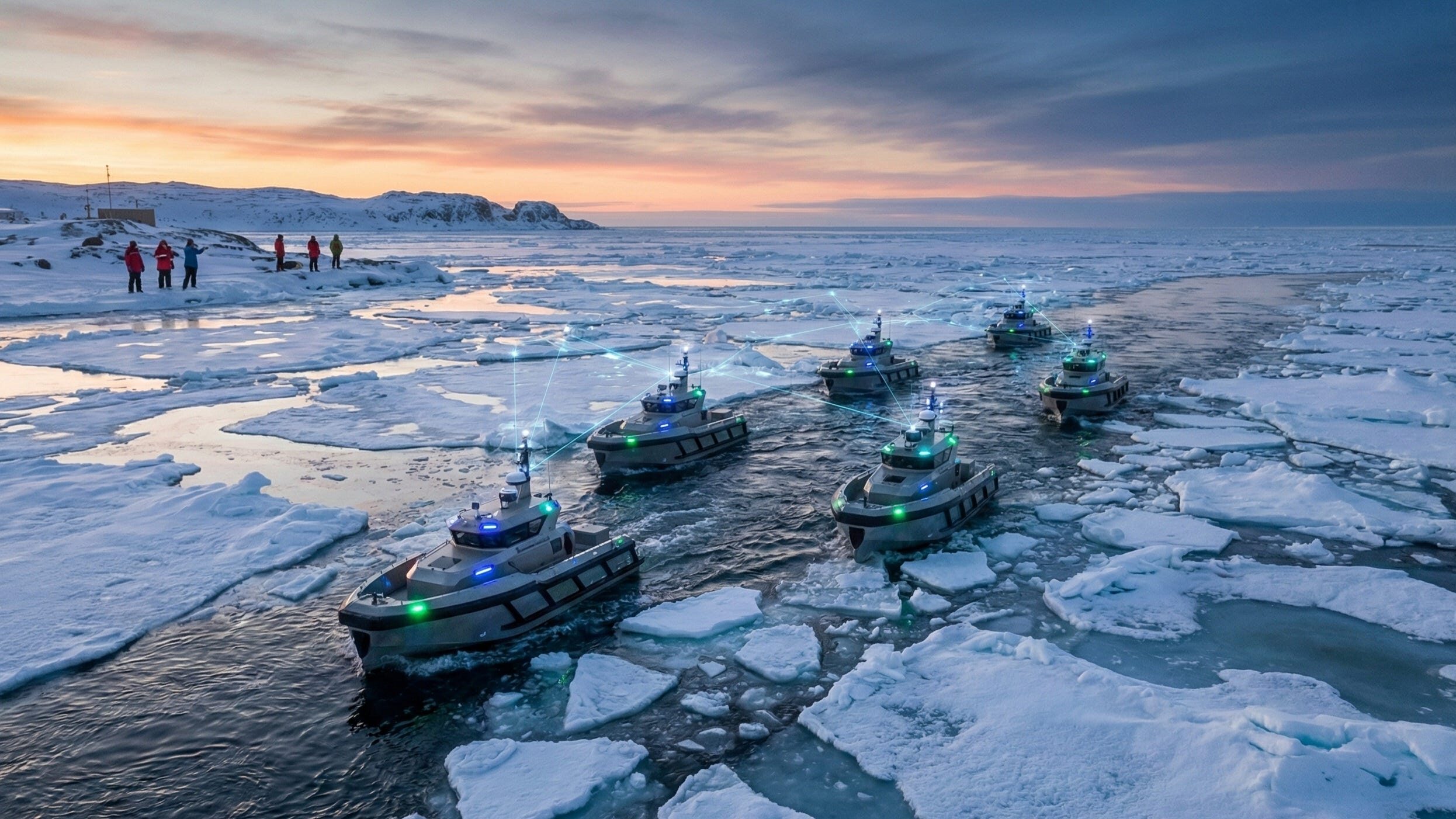
The National Research Council of Canada announced in August 2024 a collaborative project with Memorial University of Newfoundland to develop swarm-based autonomous vessels for ice management. Dr. Kevin Murrant from NRC’s Ocean, Coastal and River Engineering Research Centre partnered with Dr. Andrew Vardy, who leads Memorial’s Bio-Inspired Robotics (BOTS) lab, to tackle a persistent problem in Arctic navigation. Traditional icebreakers clear channels through ice-covered waters, but harsh conditions cause these paths to close rapidly. The research team proposes deploying fleets of smaller, self-driving vessels to push broken ice away from channels indefinitely.
Dr. Marius Seidl, a PhD candidate working toward his second doctorate, designed a computer simulator to test the AI system before physical trials. The team uses reinforcement learning, where autonomous vessels receive digital rewards for moving ice out of navigation channels and negative feedback when ice coverage increases. This approach mimics ant colonies, where individual agents work without centralized control toward a collective goal. The system will undergo testing at NRC’s offshore engineering basin facility in St. John’s, using both plastic ice substitutes and laboratory-created sea ice.
Why It Matters
The maritime autonomous surface ships market reached $4.30 billion USD in 2023 and projects growth to $9.74 billion USD by 2032, driven partly by harsh environment operations. Canada’s research positions the nation competitively in this expanding sector.
Arctic shipping faces a persistent operational challenge. Icebreakers create temporary passages, but shifting ice conditions demand constant attention. Labour costs, fuel consumption, and equipment wear make continuous icebreaker deployment economically prohibitive. A swarm of smaller autonomous vessels offers scalability and resilience. If one unit fails, others continue operations.
The technology addresses a market gap that will expand. While climate change has reduced Arctic ice extent, the International Maritime Organization projects ice will remain a navigation obstacle through 2050. Companies operating in regions like Newfoundland’s Strait of Belle Isle, where winter ferries require icebreaker escorts, could benefit from persistent ice management.
Canada’s research focuses on harsh environment expertise rather than competing in crowded autonomous shipping markets for temperate waters. Success here could position Canadian firms to export both technology and operational expertise to other ice-affected regions, including the Baltic Sea and Russia’s Northern Sea Route.
What’s Next
The research team will transition from computer simulations to physical testing at NRC’s St. John’s facility over coming months, validating whether swarm robotics principles translate effectively to ice management before open-water deployments.
The IMO’s Maritime Autonomous Surface Ships Code, expected as non-mandatory framework in 2024 with mandatory provisions by 2028, will shape international operations. Canadian regulators must decide whether to permit autonomous ice management trials in territorial waters.
Commercial viability depends on demonstrating reliable operation across seasonal variations and ice types. Questions remain about power requirements, remote communication, and maintenance logistics for distributed vessel networks.
Key Facts
- The global maritime autonomous surface ships market was valued at $4.30 billion USD in 2023
- Research collaboration between NRC’s Ocean, Coastal and River Engineering Research Centre and Memorial University’s BOTS lab
- Technology uses reinforcement learning AI to coordinate vessel swarms
- Testing will occur at NRC’s offshore engineering basin facility in St. John’s
- Project announced August 2024
Further Reading:
Maritime Autonomous Surface Ships: Creating a framework for efficiency, safety and compliance – Lloyd’s Register research on MASS implementation challenges
The Ultimate Guide to Maritime Autonomy in 2024 – Comprehensive overview of autonomous vessel technology developments
Key determinants for the commercial feasibility of maritime autonomous surface ships – Academic analysis of MASS market viability
Drivers, opportunities, and barriers for adoption of Maritime Autonomous Surface Ships – Research on MASS integration challenges
Breaking the Ice: Challenges and Opportunities of Arctic Shipping Routes – Analysis of Arctic shipping expansion