
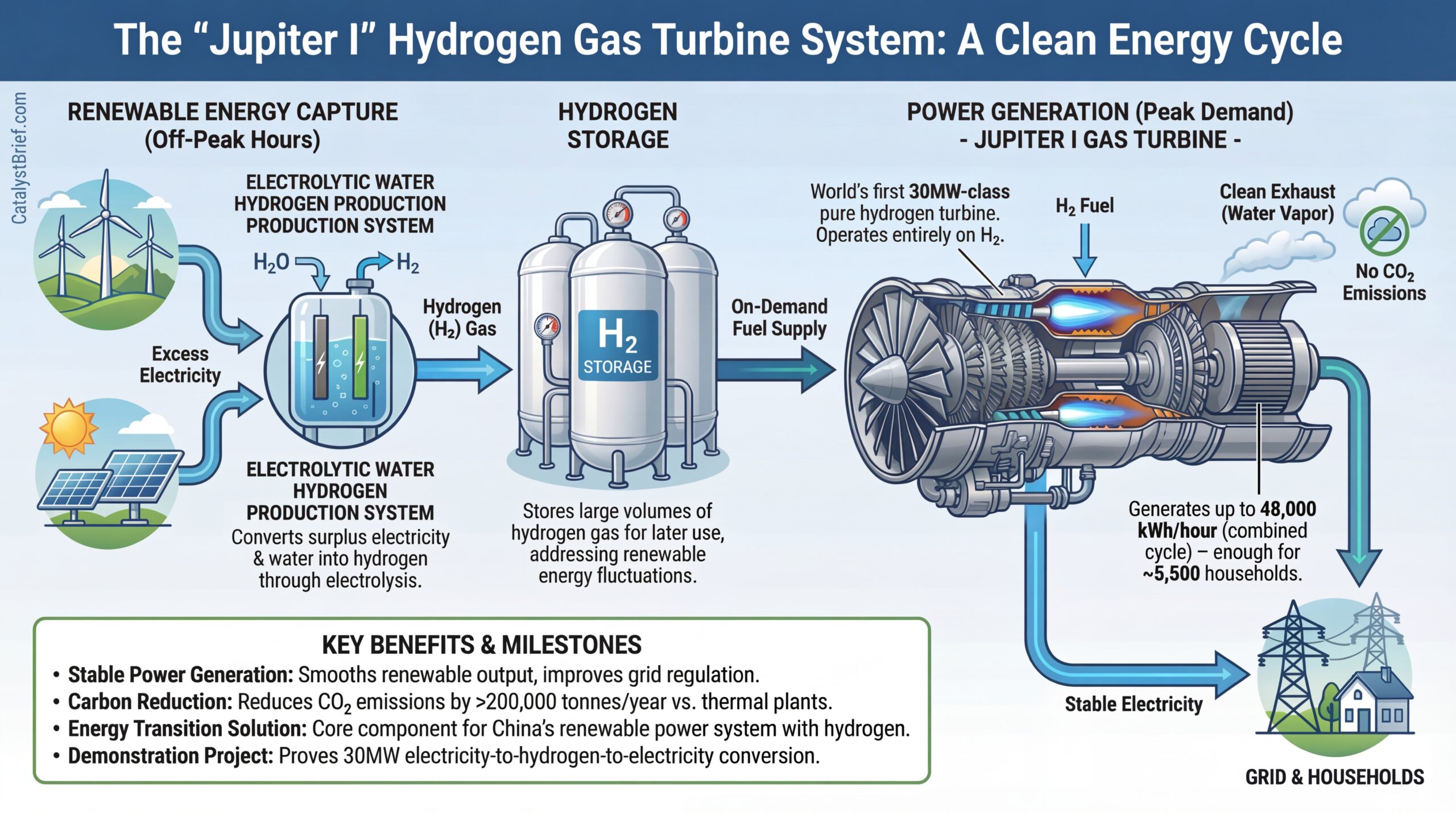
China’s Jupiter I gas turbine began stable power generation on December 22, 2024, in Inner Mongolia, marking the first commercial deployment of a 30-megawatt-class pure hydrogen turbine. Developed by Mingyang Group, the system converts surplus wind and solar electricity into hydrogen through electrolysis, then reconverts it to power during peak demand, enabling long-term energy storage with zero carbon emissions.
What Happened
The Jupiter I turbine achieved stable operation at Shenzhen Energy Corporation’s facility in Otog Banner, Ordos, representing the world’s first commercial 30-megawatt-class pure hydrogen gas turbine. The system consumes more than 30,000 cubic meters of hydrogen per hour, connecting wind farms, solar arrays, electrolyzers, and hydrogen storage in a closed-loop that addresses renewable curtailment in western provinces where up to 20 percent of capacity goes unused due to transmission constraints.
Mingyang Hydrogen Energy, subsidiary of Mingyang Smart Energy (founded 2006, Zhongshan), developed the turbine through collaboration with research institutions. The parent company ranks among leading renewable equipment manufacturers with over 40 gigawatts of wind turbines installed across 700 global wind farms.
Why It Matters
This deployment solves three interconnected problems: intermittency, curtailment, and long-duration storage. Unlike lithium-ion batteries storing energy for hours, hydrogen enables seasonal energy banking. Jupiter I balances renewable output from installations with one million kilowatts capacity, generating 48,000 kilowatt-hours per hour in combined-cycle mode, sufficient for 5,500 households daily, while reducing carbon emissions by 200,000 tons annually versus equivalent thermal capacity.
The technical achievement addresses hydrogen combustion challenges through 3D-printed combustion chamber nozzles, solving flashback, oscillation, and nitrogen oxide emissions that limited previous development. Earlier demonstrations peaked around 5 to 10 megawatts and retrofitted natural gas systems rather than purpose-built hydrogen designs. Jupiter I represents the first large-scale, commercially operating pure hydrogen turbine purpose-designed for energy storage applications.
China’s curtailment worsened substantially in 2024, with solar reaching 6.6 percent in first half 2025 versus 3.9 percent in 2024, while wind rose to 5.7 percent from 3 percent. Tibet curtailed 30.2 percent of wind and 33.9 percent of solar. Hydrogen-based storage provides scalable solutions for this wasted capacity.
What’s Next
The Ordos facility will demonstrate scaling pure hydrogen turbine technology to higher capacities across China’s western provinces. Mingyang plans integration with a 150,000-ton-per-year green ammonia plant, creating dual pathways: direct power generation during peak demand and ammonia synthesis for shipping fuel and industrial applications. The ammonia component provides transportable energy carriers, extending impact beyond grid stabilization.
Successful operation addresses critical questions about economics, maintenance intervals, and renewable integration. Performance data on combustion stability, electrolyzer utilization, and storage efficiency will influence deployment decisions in regions from Patagonia to Western Australia.
Key Facts
- Capacity: 30-megawatt pure hydrogen gas turbine with 10 firing chambers
- Hydrogen consumption: More than 30,000 cubic meters per hour, equivalent to 10,000 tons annually
- Power output: 48,000 kilowatt-hours per hour in combined-cycle mode, 200 gigawatt-hours annually
- Emissions reduction: More than 200,000 tons of carbon dioxide annually versus equivalent thermal power
- Location: Otog Banner, Ordos, Inner Mongolia at Shenzhen Energy Corporation facility
- Developer: Mingyang Hydrogen Energy, subsidiary of Mingyang Smart Energy (founded 2006, Zhongshan, Guangdong)
- Operational date: December 22, 2024
- Technology: Purpose-built turbine with 3D-printed combustion chamber nozzles solving flashback and oscillation challenges
- Integration: Part of closed-loop system connecting 505 MW wind capacity with solar, electrolyzers, and ammonia production
- Market context: China’s renewable curtailment rose to 6.6 percent for solar and 5.7 percent for wind in first half 2025
Further Reading:
China’s renewable energy curtailment challenges examine provincial disparities in clean energy utilization rates.
Global Energy Monitor’s analysis of China’s wind and solar construction quantifies the scale of deployment versus grid integration capacity.
Mingyang Smart Energy’s corporate profile details the company’s broader renewable energy portfolio and offshore wind leadership.
Shenzhen Energy Corporation’s integrated facility documentation outlines the complete wind-solar-hydrogen-ammonia system architecture.
Technical analysis of China’s hydrogen infrastructure development provides engineering details on electrolyzer specifications and water management challenges.